
Having a great book idea is only the beginning. The real challenge comes with writing, editing, designing the cover, formatting, preparing metadata, and getting everything ready for Amazon KDP. Royalty Profits AI Vol. 2 aims to simplify this process by bringing multiple publishing tasks into one AI-powered platform. It is designed to assist with book creation, formatting, covers, campaign management, translation, and other KDP-related tasks.
According to the vendor's JV materials, Vol. 2 includes an upgraded Book Creation Engine, Campaign Dashboard, Character and World Libraries, author profiles, and translation features. However, generating a book quickly doesn't guarantee sales. In this Royalty Profits AI Vol. 2 Review, we'll look at the $27 entry offer, available upgrades, key features, and whether the platform can genuinely make KDP publishing easier.
👉 Explore the Official Page Before Making a Decision
Royalty Profits AI Vol. 2 at a Glance
Product: Royalty Profits AI Vol. 2
Also called: RP-AI Vol. 2 / RPAI Vol. 2
Main purpose: AI-assisted KDP book creation and publishing
Front-end: $27 Basic License
Commercial License: $37
Pro Suite: $47
Research Module: $37
Reader Magnet System: $37
eBook Genius: $27
DFY Package: $197
DFY Starter Downsell: $97
VIP All-Access: $247
Guarantee: 30 days
AI API: User supplies API keys
Translation: Up to 12 languages according to launch materials
Best for: Authors, KDP publishers, self-publishers, and publishing service providers
The vendor's current JV page lists the launch funnel from $27 to $247 and states that the front-end launch price increases to $47 after the launch period.
What Is Royalty Profits AI Vol. 2?
Royalty Profits AI Vol. 2 is essentially an AI-powered book production system built around the Amazon KDP workflow.
That's important because there is a difference between an AI writer and an AI publishing workflow.
A normal AI chatbot can help you write, but after writing, you still need to figure out:
How to structure the book
How to create a cover
How to format the manuscript
How to create metadata
How to organize multiple projects
How to handle recurring characters
How to translate the book
How to prepare PDF and EPUB files
How to move everything into KDP
RP-AI Vol. 2 attempts to bring many of those jobs into one platform.
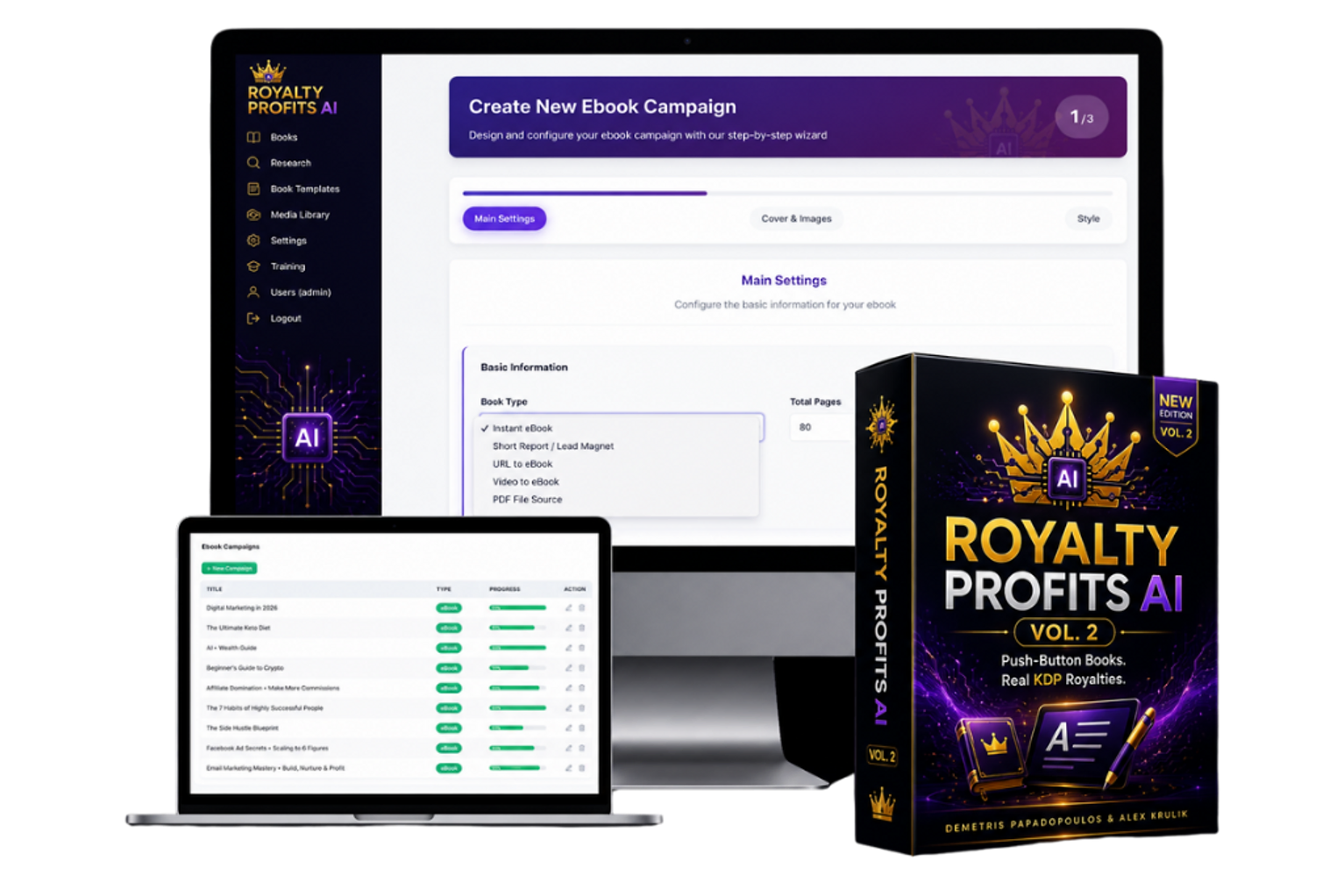
The vendor says the Vol. 2 rebuild includes a Campaign Dashboard, upgraded Book Creation Engine, Default Author Profile, Character and World Libraries, and one-click translation into up to 12 languages.
That makes the product particularly interesting for someone who doesn't just want to create one book, but wants to build a repeatable publishing workflow.
The Real KDP Problem RP-AI Vol. 2 Is Solving
Here's where the product makes the most sense.
Imagine you're a beginner with a great nonfiction book idea.
You start writing. Then you realize you need 10 or 15 chapters. You ask AI to help, and now you have multiple sections that don't quite sound consistent.
You edit them.
Then you need a cover, so you open Canva. Next comes interior formatting. Then EPUB conversion. After that, you need a description, keywords, categories, and metadata.
Finally, you upload everything to KDP and discover another formatting problem.
This is the finishing problem.
KDP may initially look simple, but publishing a quality book involves niche selection, manuscript creation, editing, formatting, covers, descriptions, keywords, categories, metadata, and KDP-ready files.
That's why the most interesting promise of RP-AI Vol. 2 isn't simply:
"AI can write a book."
Everyone already knows AI can write.
The more interesting question is:
"Can one publishing workflow reduce the friction between a book idea and a finished KDP project?"
That's the question worth considering.
How Does RP-AI Vol. 2 Work?
The basic workflow can be understood as:
Book idea → AI creation → Editing → Design → Formatting → Optimization → KDP
You start with your topic or concept.
The platform then assists with creating the book and its associated publishing assets. You can review the output, make changes, and prepare the project for publishing.
The vendor's JV materials claim that the upgraded engine can produce a complete book in under six minutes while also emphasizing PDF/EPUB export and multiple book types.
However, "in minutes" should be interpreted carefully.
AI generation time is not the same as finished publishing time.
You still need to:
Review the manuscript
Check facts
Inspect the cover
Review formatting
Check the final KDP listing
Confirm that the content meets your quality standards
You should never assume that a generated book is automatically commercially competitive simply because the software generated it quickly.
👉 Check the Official Page for Availability & Pricing
RP-AI Vol. 2 Features & Benefits
1. Upgraded AI Book Creation Engine
The core feature is the book creation engine.
The vendor's JV materials say the engine supports more than 25 book types and can generate books in under six minutes.
For beginners, the obvious benefit is getting past the blank-page problem.
Instead of spending hours deciding what comes next, you can use AI to establish the basic structure and draft.
For experienced publishers, the benefit is different.
It is potentially about production speed.
You can use AI output as a starting point and spend more time improving the content instead of creating every paragraph from scratch.
2. Campaign Dashboard
The new Campaign Dashboard is one of the features that separates Vol. 2 from a simple AI writing tool.
The vendor says users can manage books through campaigns and track information such as drafts, sales, royalties, and KENP reads.
This becomes more useful as your catalog grows.
One book is easy to manage manually.
Twenty books are different.
Fifty books create another level of organization.
A centralized dashboard can potentially make a growing publishing operation easier to organize.
3. Character Library
If you're writing fiction, this feature could be particularly useful.
A recurring character needs consistency. Their appearance, personality, background, and role shouldn't randomly change from one book to another.
The Character Library is designed to retain character information that can be reused across books, interiors, and covers.
This makes RP-AI Vol. 2 particularly relevant for:
Romance series
Fantasy
Children's stories
Mystery series
Science fiction
Other recurring-character fiction
4. Worlds Library
The Worlds Library takes the same concept one step further.
If you're building a fictional universe, you need consistency across:
Locations
Rules
Characters
History
Relationships
Setting details
Instead of recreating that information every time, the system can retain world information for future projects.
For someone creating one nonfiction ebook, this isn't a major selling point.
For a series author, however, it could become one of the more useful features in the platform.
5. Default Author Profile
This sounds like a small feature, but small workflow improvements matter.
Instead of repeatedly entering the same author information, the Default Author Profile allows your name and bio to be stored and reused.
That's particularly useful when producing multiple books.
It turns:
Enter author details → enter author details → enter author details
into:
Set once → reuse.
The vendor specifically identifies this as one of the new Vol. 2 capabilities.
6. One-Click Translation
The platform also offers book translation into multiple languages, with the JV page stating support for up to 12 languages.
This creates an interesting opportunity.
Instead of creating one book for one market, you can potentially adapt the same publishing asset to additional language markets.
However, don't confuse AI translation with professional localization.
A serious publisher should still review translated content for:
Meaning
Tone
Grammar
Cultural context
Idioms
Genre conventions
The software can accelerate translation.
It doesn't eliminate quality control.
7. PDF and EPUB Export
Formatting is one of the least glamorous parts of publishing.
It's also one of the areas where beginners frequently get stuck.
RP-AI Vol. 2 provides PDF and EPUB export, allowing users to prepare books for digital publishing. The JV materials specifically position the files as formatted for Amazon KDP.
This is another reason to think of RP-AI Vol. 2 as a workflow rather than simply a writing assistant.
8. AI Cover Creation
The vendor's promotional material highlights multiple AI cover models, including DALL-E 3, GPT-Image-1, and Nano Banana.
This can potentially eliminate the need to immediately hire a designer for every experimental book.
But there is an important buyer lesson:
A technically correct cover isn't automatically a good-selling cover.
Your cover still needs to communicate:
Genre
Audience
Topic
Quality
Emotional promise
It also needs to remain readable when displayed as a small Amazon thumbnail.
9. Book Metadata and Publishing Assets
The Pro Suite expands the publishing workflow with tools for titles, subtitles, categories, keywords, author bios, templates, and formatting.
The vendor specifically lists smart title/subtitle generation, category and keyword research, cover design, custom templates, and KDP compliance checking among the Pro features.
That is useful because book creation isn't just a writing exercise.
You are creating a product.
And products need positioning.
10. Book Factory and Auto Series Generation
This is one of the Vol. 2 additions that deserves attention.
The Pro Suite introduces Book Factory, which is designed for batch book generation, along with automatic series generation.
This changes the potential use case.
Instead of asking:
"Can this help me make one book?"
You can ask:
"Can this help me build a catalog?"
That is a much more relevant question for serious KDP publishers.
👉 Review the Full Program Details Before Buying
RP-AI Vol. 2 vs ChatGPT: Why Pay for Another AI Tool?
This is one of the first objections many buyers may have.
"If I already have ChatGPT, why do I need RP-AI Vol. 2?"
It's a fair question.
ChatGPT is extremely flexible. You can use it for:
Research
Brainstorming
Writing
Editing
Outlines
Marketing
Titles
Descriptions
But ChatGPT isn't specifically designed to manage your entire KDP publishing workflow.
You still have to handle:
Book files
Covers
Formatting
Metadata
Publishing organization
Multiple campaigns
Characters
Worlds
RP-AI Vol. 2 is more specialized.
The difference can essentially be understood as:
ChatGPT = general AI assistant
RP-AI Vol. 2 = KDP-focused production environment
If you're comfortable building your own workflow, ChatGPT may be enough.
If you want a more centralized publishing system, RP-AI Vol. 2 becomes more relevant.
RP-AI Vol. 2 Pricing: What Does $27 Actually Get You?
The front-end price is currently $27 for the Basic License.
The Commercial License is $37.
The vendor's JV page says launch pricing increases to $47 after the launch period.
The Basic offer is the place to start if you're primarily interested in the core AI publishing platform.
The Commercial License is more relevant if you're planning to create books commercially for clients or use the software as part of a publishing service.
However, the $27 purchase isn't the complete funnel.
There are optional upgrades.
RP-AI Vol. 2 OTOs: Do You Need Them?
The current structure from the JV materials includes:
OTO 1: Professional Suite — $47: Advanced KDP publishing and Book Factory
OTO 2: Research Module — $37: 11 research tools
OTO 3: Reader Magnet System — $37: List building and reader magnets
OTO 4: eBook Genius — $27: Audiobook, video book, and PLR conversion
OTO 5: DFY Package — $197: Done-for-you publishing
OTO 5 Downsell — $97: Smaller DFY package
VIP All-Access — $247: Lifetime access to the broader stack
OTO 1 — Professional Suite
At $47, this is arguably the most important upgrade for someone who wants to turn RP-AI Vol. 2 into a more complete KDP publishing workflow.
It adds:
Direct KDP publishing workflow
Smart title/subtitle tools
Category and keyword research
Professional cover designer
Author bio generator
Custom templates
Auto-formatting
Book Factory
Auto series generation
The vendor says the system can connect to KDP through OAuth and prepare books as drafts, with the user retaining final review and publishing control.
That's an important distinction.
It isn't accurate to describe this as AI publishing everything without the user.
You still need to review the final listing.
OTO 2 — Research Module
The Research Module costs $37 and includes 11 research tools covering areas such as popular books, competitors, trending topics, target audiences, and content gaps.
I'd consider this most relevant to people who struggle with:
"What should I write?"
rather than:
"How do I write it?"
OTO 3 — Reader Magnet System
At $37, this is aimed at building an audience around the book.
It includes:
AI reader magnet generation
Landing page builder
Thank-you page
QR codes
Six email integrations
Subscriber management
CSV export
Meta Pixel and Conversions API
This makes it less about book creation and more about turning readers into an owned audience.
OTO 4 — eBook Genius
At $27, eBook Genius is positioned as a content-repurposing tool.
The vendor highlights:
AI audiobook generation
Video book creation
PLR conversion
This could help publishers get more mileage out of an existing manuscript.
OTO 5 — DFY Package
This is the major done-for-you upgrade at $197.
The vendor describes a package including four professionally written and edited books, an author website, 90 days of Pinterest traffic, market research, formatting, and other assets.
There's also a $97 downsell with a smaller package.
This isn't necessary for someone who wants to learn and do the work themselves.
It's aimed at buyers who place a higher value on outsourcing.
What Is the $247 VIP All-Access?
The VIP offer is currently $247.
It's positioned as lifetime access to the broader Vol. 2 ecosystem, including the major upgrades and additional VIP benefits.
The JV page lists the front-end features, Professional Suite, Research, Reader Magnet System, eBook Genius, and DFY package credits among the included components.
The important question isn't whether VIP looks like a better mathematical deal.
The better question is:
Will you actually use the additional tools?
If you're publishing one or two books, the additional stack may not be necessary.
If you're building a serious catalog, agency, or publishing operation, the calculation becomes different.
RP-AI Vol. 2 Bonuses
The official front-end offer includes four bonuses with a stated combined value of $248:
Quick Start Blueprint
10 Hot Niches Guide
Cover Design Templates
Amazon Ranking Guide
These are useful additions, particularly for beginners who don't already have a KDP publishing process.
But I wouldn't buy the software purely for the bonuses.
The core software should be the reason you purchase.
👉 Grab Your Exclusive Bonus + OTOs
What About AI API Costs?
Here's something many buyers overlook.
RP-AI Vol. 2 requires users to supply their own AI API keys.
The JV materials estimate AI usage at roughly $0.02–$0.10 per book, although actual costs can vary depending on usage.
So don't think of the economics as:
"$27 and everything is unlimited."
A better way to think about it is:
Software access + AI usage + optional upgrades
The estimated per-book API cost may be small, but it is still worth knowing before purchasing.
RP-AI Vol. 2 User Experience: What Should You Expect?
One competitor's review used a 10-day testing angle and focused on whether the software actually reduced the heavy lifting involved in KDP publishing.
That's the right question.
Not:
"Can AI generate words?"
But:
"Does this make my publishing workflow easier?"
For a beginner, the biggest UX benefit is likely consolidation.
Instead of moving through:
AI writer → image generator → design tool → formatting tool → KDP
you can perform more of the process inside one publishing-focused environment.
For an experienced publisher, the potential advantage is speed and repeatability.
But there is still a learning curve.
You need to understand what makes a good book.
You need to understand KDP.
You need to review your content.
And you need to understand your market.
The software can remove repetitive work.
It can't replace publishing judgment.
The 7 Things I'd Check Before Publishing an RP-AI Book
Before uploading any AI-assisted book, I'd check:
1. Content Quality
Does it actually help the reader?
2. Repetition
AI-generated manuscripts can repeat ideas or phrases.
3. Factual Accuracy
This is especially important for nonfiction.
4. Human Readability
Does it sound natural, or does it sound like obvious AI output?
5. Cover Quality
Does the cover communicate the book's genre and audience?
6. Formatting
Check the actual Kindle/KDP preview rather than trusting the generated file blindly.
7. KDP Requirements
You remain responsible for complying with Amazon's current policies, intellectual-property rules, and AI-content requirements.
The Professional Suite's FAQ makes clear that users retain final publishing responsibility and must review the listing and required declarations.
That's the mindset I'd recommend.
RP-AI Vol. 2 Pros and Cons
Pros
KDP-focused AI workflow
Book creation engine
Campaign Dashboard
Character Library
World Library
Default Author Profile
Translation support
PDF and EPUB export
AI cover generation
Metadata assistance
Optional direct KDP workflow
Book Factory for batch creation
Auto series generation
Research tools available as an upgrade
Reader list-building system available as an upgrade
Commercial License available
30-day guarantee
Low $27 entry price during launch
Cons
AI output still requires human review
API costs are separate
Some advanced features require upgrades
The complete funnel can cost significantly more than $27
KDP sales are not guaranteed
Translation still needs quality control
Beginners still need to understand KDP
Faster book production doesn't automatically mean stronger market demand
Is RP-AI Vol. 2 Legit?
This is probably the biggest question behind searches like "Is RP-AI Vol. 2 legit?"
Based on the current product and JV information, it is presented as a real software product with a publishing platform, multiple tools, support information, and a 30-day money-back guarantee. The vendor identifies Demetris Papadopoulos and Alex Krulik as the JV managers/creators associated with the launch.
But there is an important distinction:
Legitimate software does not mean guaranteed income.
RP-AI Vol. 2 can potentially make book production faster.
It cannot guarantee that Amazon customers will buy your books.
Your results will still depend on:
Niche selection
Demand
Book quality
Cover
Listing optimization
Pricing
Competition
Reviews
Promotion
That is the realistic way to look at it.
Who Should Buy Royalty Profits AI Vol. 2?
It makes the most sense to consider for:
1. Beginners
Especially those who have ideas but struggle to turn them into finished books.
2. Existing KDP Publishers
The time-saving potential becomes more relevant when producing multiple titles.
3. Fiction Authors
The Character and World Libraries are particularly relevant for series.
4. Nonfiction Publishers
The research, metadata, and content workflow can potentially simplify repetitive production.
5. Agencies and Freelancers
The Commercial License may make sense for client work.
6. Catalog Builders
If your goal is to develop a larger publishing catalog rather than one book, the campaign and batch-generation features become more relevant.
Who Should Avoid It?
I'd think twice if you're looking for:
Guaranteed royalties
Completely passive income
Zero editing
Zero KDP knowledge
A magic "publish and profit" button
Unlimited AI usage included in the $27 price
The software can accelerate production.
It doesn't create demand.
Frequently Asked Questions
1. Is Royalty Profits AI Vol. 2 suitable for KDP beginners?
Yes. It is designed to simplify several steps of the KDP publishing process, making it potentially useful for beginners who don't want to manage multiple tools.
2. Can RP-AI Vol. 2 help create books in different languages?
Yes. The platform includes translation functionality, with the launch materials stating support for up to 12 languages. However, translated content should still be reviewed for accuracy and natural readability.
3. Can I use RP-AI Vol. 2 to create a series of books?
Yes. Its Character Library, World Library, and Auto Series Generation features are particularly useful for authors who want to maintain consistency across multiple books in a series.
4. Does RP-AI Vol. 2 handle the entire publishing process automatically?
Not completely. The platform can assist with many publishing tasks, but users still need to review their content, formatting, metadata, and final KDP submission.
5. Is RP-AI Vol. 2 useful for publishing multiple books?
It can be. Features such as the Campaign Dashboard and Book Factory are designed to make managing and generating multiple publishing projects more efficient.
6. Can RP-AI Vol. 2 guarantee book sales?
No. The software can help streamline production, but sales depend on factors such as niche selection, book quality, demand, pricing, competition, reviews, and marketing.
Final Verdict
Royalty Profits AI Vol. 2 stands out more as a KDP productivity platform than a tool promising easy income. Its biggest benefit is bringing several publishing tasks together, helping users turn an idea into a more complete, publishable book while cutting down on repetitive work.
The current offers include:
$27 Basic: A good starting point for beginners.
$37 Commercial: More suitable for client projects.
$47 Pro: For users who want advanced publishing features.
$37 Research: Helpful for researching niches and topics.
$37 Reader Magnet: Designed for growing a reader email list.
$27 eBook Genius: Useful for turning existing content into other formats.
$197 DFY: For those who prefer a done-for-you approach.
$247 VIP: Worth considering only if you need several additional tools.
Keep in mind that creating books faster doesn't guarantee KDP sales. Content quality, editing, niche selection, cover design, listing optimization, competition, and marketing still matter.
Bottom line: RP-AI Vol. 2 may be a useful option if you're struggling with the time and complexity of KDP publishing. Just treat it as a tool for streamlining your workflow—not as a guaranteed way to make money.
👉 Check What You Get Before Placing Your Order





Write a comment ...